Sword and Stone
Project Overview
Taking inspiration from the legendary take of King Arthur and Excaliber, we wanted to make an electromechanical system to recreate the story and see if we were worthy!
Duration
1 Month
Team Project
My job: Modeling and fabrication of the sword, assisting with the stone configuration/locking mechanism

Ideation
We wanted to create a sword that would only lift out of it’s “stone” for the three of us on the team through use of a fingerprint scanner that would be connected to the sword so when a person held the hilt, their finger would be scanned and the sword would (if they were “worthy”) unlock and be able to lift out of the box. We also decided to incorporate a celebratory LED display on the stone for fun but also to communicate what state the fingerprint scanner was at (waiting, finger print accepted, fingerprint rejected.)
We first identified three main tasks to break the project down into: the sword, the fingerprint scanner, and the stone with its locking mechanism and light display. While we all helped and assisted each other along the way, I was tasked specifically with modeling and fabricating the sword and working to create its locking method along with Zahra who was on “stone”/LED duty.
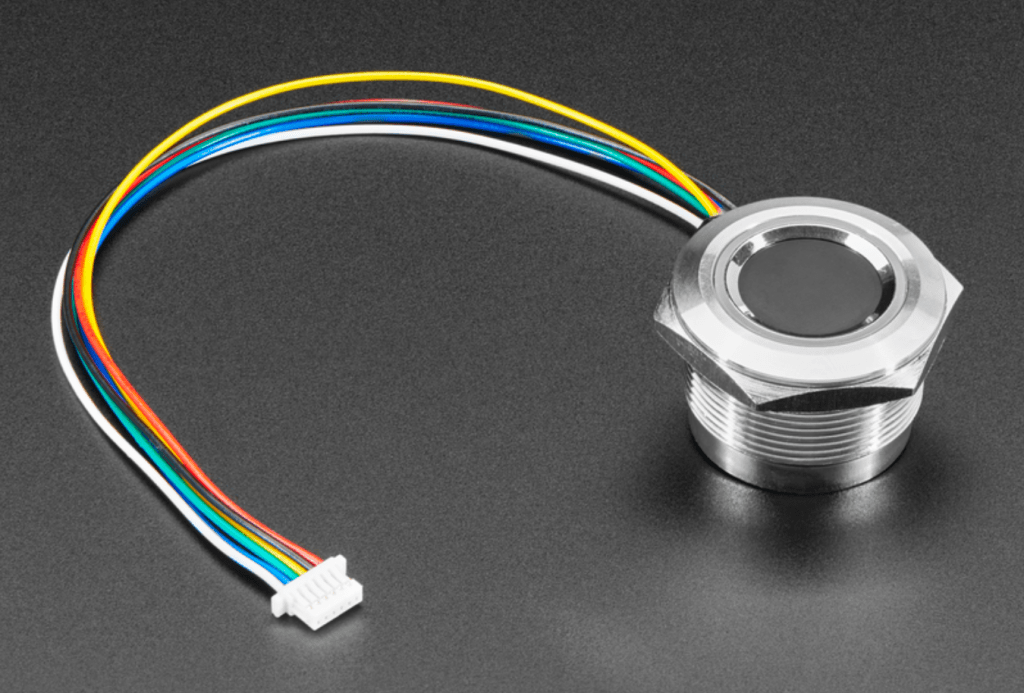
Fingerprint Scanner
The scanner was something that none of us had any previous knowledge of, so Elana, whose main task this was, ran into a number of challenges including: proper wiring to the arduino, understanding different fingerprint sensor libraries, initializing our prints into the system, coding proper/improper recognition of fingerprints, learning how the device stored its fingerprint bank in memory, and linking the LED display to the fingerprint sensors data.
We assisted her the best we could in tackling each of these problems one at a time with a lot of research, trial and error, discussion, and patients.

Locking Mechanism
Once we had the fingerprint scanner working we started implementing our locking mechanism. We decided on a solenoid which we had come across earlier in the course and learned to code it to lock and unlock on cue. The plan was to drill a hole in the bottom of the sword for the solenoid to pop into in the “on” state, holding it in place, and then when the fingerprint was accepted to pop out in the “off” state, releasing the sword.
The Sword (My main job)
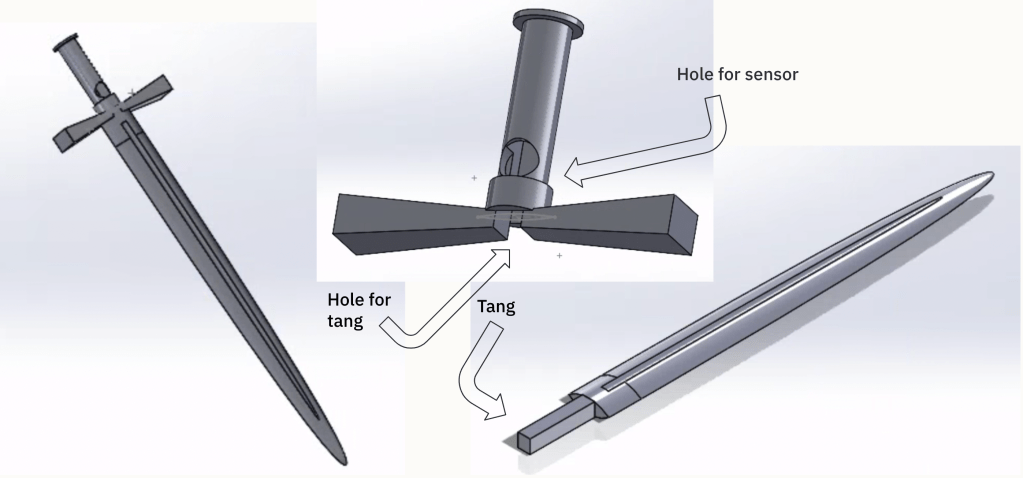
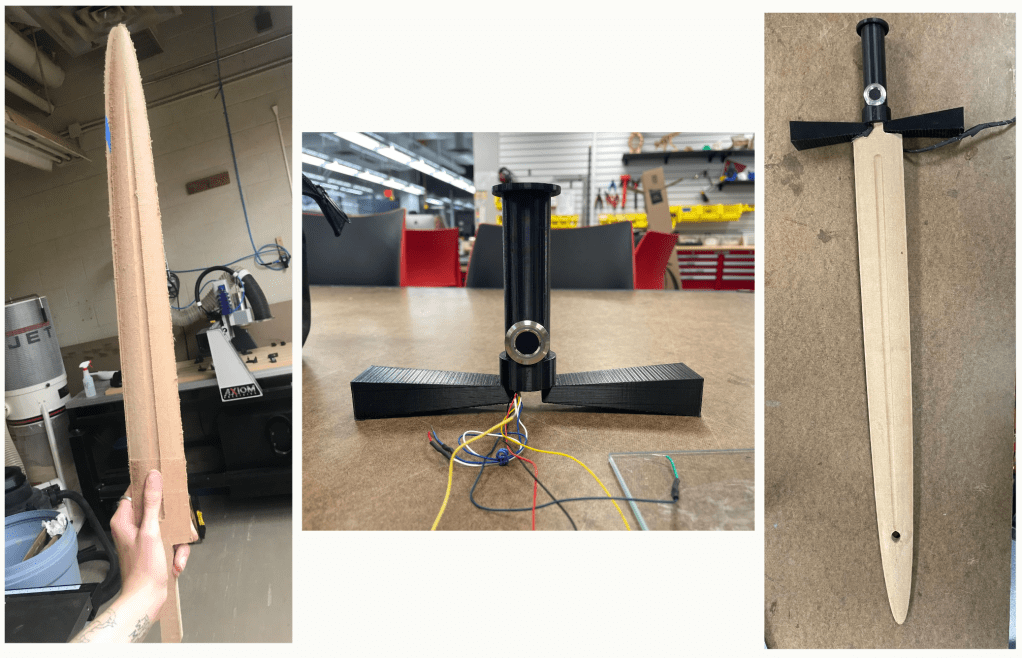
The real challenge that came with the sword was learning that I could not just 3D print the whole thing because our printers were too small and I couldn’t CNC route it because of the routers restricted up and down movement not allowing to carve out the cylindrical handle. Because of this limit I had to pivot some and think about breaking the sword up. I decided the easiest solution was printing the handle and routing the blade and then combining the two through use of a tang like seen in kitchen knives.
While modeling the sword in solidworks I had to keep in mind the hole on the hilt for the sensor and how that interacted with the tang. I tried my best in solidworks to make sure there was space, but when it got printed the sensor was a little tight to I ended up just sanding down the plastic and that seemed to work.
The Stone (side job)
We laser cut and engraved a large box with a hole in the top for the sword to be our stone and hide all of our electronics and mechanical parts. We soon realized that while our locking mechanism in theory worked, in reality, the sword had to be placed in such a specific place for the solenoid to go through the hole and lock, that 95% of the time our lock was failing. To remedy this we made a sort of shaft with ribbing on the inside that would perfectly hold the sword in place as a person put it back through the stone for the next go.


Assembled
1. We place our finger on the scanner
2. Assuming its someone from the team, the scanner goes from blue to purple. The solenoid unlocks. The LED strip goes from purple to rainbow.
3. The sword is then removed.
If the person is “unworthy” (not one of us), the scanner and LED strip turn red and the solenoid stays locked.
For the Future
While the inside of the stone is not seen by viewers, for our own sakes we would like it to be a little cleaner and neater. In a similar vein, we were a little pressed for time by the end (as can be seen by our hectic photos) so we would love some more time to revisit our design and improve user experience as well as overall system interaction.
 Sydney Keller